2D Games
Daedalic Entertainment over the years has released some really nice looking games.
Here is a list of some of them that I think are relevant to my project:
Memoria
Daedalic Entertainment. 2013.
Memoria. Microsoft Windows. Deep Silver and Daedalic Entertainment.
Daedalic Entertainment. 2013. [online image]. Available from:
http://www.daedalic.de/en/game/memoria [Accessed 26 January 2014]
Memoria is a point-and-click adventure game based on the events of Previous Daedalic Entertainment game ‘
Chains of Satinav’. It builds on the previous story and includes puzzles as part of a gameplay. This game is praised for its visual style and quality of the art. Daedalic also boasts on its website that one of the games features is '
120 marvellous, hand drawn backgrounds, each breathing life into the game’s world'. Voice acting however seem to be a bit of a letdown unfortunately
.
The Dark Eye: Chains of Satinav
Daedalic Entertainment. 2012.
The Dark Eye: Chains of Satinav. Microsoft Windows. Deep Silver and Daedalic Entertainment.

Daedalic Entertainment. 2012. [online image]. Available from:
http://www.daedalic.de/en/game/DSA_Satinavs_Ketten#5 [Accessed 26 January 2014]
This game is based of
The Dark Eye, Europe's best-known role-playing brand that has been around for more than 25 years.
TDE: Chains of Satinav is a point-and-click adventure with incorporated puzzles. Story is based in the town/village of Andergast, world of Aventuria. Just like other Daedalic Entertainment games it stands out by having hand drawn/painted artwork.
"
Each location has its own distinctive colour palette, instantly creating an atmospheric mood. When you approach a rundown hut in the dark, set against a cloudy sky and decomposing wood backdrop bathed in blues, it’s clear that something sinister is afoot. A harbour town and its dock are made up of browns and greys, bright light shining only from windows, highlighting the poverty that lingers on each corner. The detailed settings draw you in and make the world feel entirely believable, though ambient movement is minimal, sticking to mostly simple things like rising mist or gushing water."*
Fantasy atmosphere is enriched with music which changes or goes silent as the mood of the game and the story turns 'darker' and more menacing. "
A slow, sinister string piece is set against the beating of rain to create a shady atmosphere down at the docks, and when entering a dream world the music becomes ethereal, yet still retaining a strong tension that reminds you of lurking danger." *
However it seems to suffer from the same bad voice acting issue like majority of the other Daedalic Entertainment games.
One of the mentioned game downfalls is a lack of animation or animation being really 'choppy' which takes away from the game and makes it tacky and boring. Lack of emotion in character performance prevents players from bonding with the character and hinders his/hers involvement with the story.*
Also, "
... a black loading screen that happens every time you change location or begin a conversation, which snaps you out of the experience for a moment when it should have been done seamlessly (or at least less intrusively)."*
* Keeley, J. 2012.
The Dark Eye: Chains of Satinav review. [online]. Adventure Games. Available from:
http://www.adventuregamers.com/articles/view/21919 [Accessed 26 January 2014]
In my opinion Joe Keeley made some valid points regarding animations, loading screens and sound. I think it does prove those nice painted images which in this case may resemble nice concept art, book illustration or even animation, is not enough for the game. Since game is interactive and things/characters move around the screen, quality and amount of animation is just as important not only for the 'finished' look/feel but also for payers involvement within the story, world and empathy towards the main character. Also, because sound plays a big role in players immersion quality, its quality is also important. Video game is a really complex system, especially if it attempts to tell a story and each of the game elements and its quality plays important part to the whole.
The Whispered World
Daedalic Entertainment. 2010.
The Whispered World. Microsoft Windows. Viva Media and Lace Mamba
.
Daedalic Entertainment. 2010. [online image]. Available from:
http://www.daedalic.de/en/game/The_Whispered_World#23 [Accessed 26 January 2014]
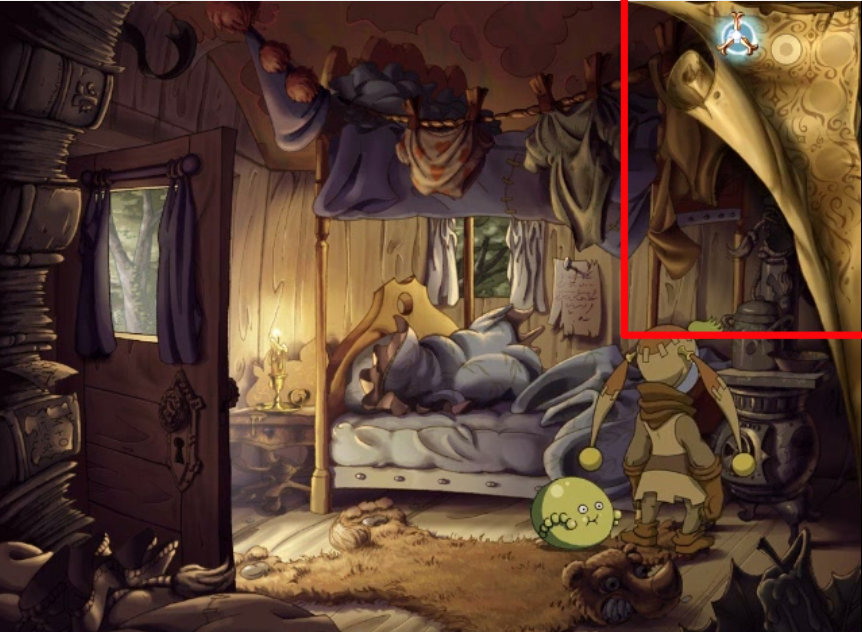
The Whispered World is another point-and-click puzzle fantasy adventure game from Daedalic Entertainment. The story is about a young clown called Sadwick and his pet companion Spot. As far as I know, it started its life as a graduation project and after a number of years has been developed in to a finished videogame. It is dialogue heavy and has a good story with some nice characters; however it also suffers a little bit from bad voice acting (English version). Also, just like the rest of Daedalic games, it has that amazing hand painted game art. It certainly reminds a lot of traditional fairy-tale animations with Disney like backgrounds. Actual character animations are not very well done, but not as bad or as noticable as in
The Dark Eye: Chains of Satinav.
One of the downfalls of the game from the interactivity point of view are 'hidden' items (collectables, or intractable objects) that can only be found while randomly clicking around the screen. Perhaps making them slightly more visible to a player would make for a better gameplay flow.
A New Beginning
Daedalic Entertainment. 2012.
A New Beginning. Microsoft Windows. Daedalic Entertainment.
Daedalic Entertainment. 2012. [online image]. Available from:
http://www.daedalic.de/en/game/A_New_Beginning#9 [Accessed 26 January 2014]
A New Begining is described as "
a cinematic, interactive adventure-thriller that deals with the defining issue of our time."** It is another point-and-click puzzle adventure however this time players can control two characters: scientist Bent Svensson who's been working on eco-friendly alternative energy source and Fay, a young woman sent from the future to prevent an impending environmental catastrophe.
As a standrad game features detailed, hand-painted backgrounds, however this game also has incorporated an animated graphic-novel story telling "
with more than 40 minutes of animated comic book cutscenes".** Art overall looks very similar to the previously mentioned games however not as detailed or painterly as previously. Possibly because there are many characters within the game, developers chose to resemble more comic book art style. Especially, since quite a few scenes feature dialogue (animated faces) and it would have been to consuming to paint everything/everyone in a high detail.
**Daedalic Entertainment. 2014. A New Begining. [online]. Daedalic Entertainment. Available from:
http://www.daedalic.de/en/Game/A_New_Beginning [Accessed 26 January 2014]
The Night of the Rabbit
Daedalic Entertainment. 2013.
The Night of the Rabbit. Microsoft Windows. Daedalic Entertainment.
Daedalic Entertainment. 2013. [online image]. Available from:
http://www.daedalic.de/en/Game/The_Night_of_the_Rabbit [Accessed 26 January 2014]
The Night of the Rabbit is a point-and-click adventure where main character is a 12 year old boy called Jerry who dreams of one day becoming a wizard. Again, this game contains the same art style that reminds more an animation or a book illustration rather than a video game.
Goodbye Deponia
Daedalic Entertainment. 2013.
Goodbye Deponia. Microsoft Windows. Daedalic Entertainment
Chaos on Deponia
Daedalic Entertainment. 2012.
Chaos on Deponia. Microsoft Windows. Daedalic Entertainment
Deponia
Daedalic Entertainment. 2012.
Deponia. Microsoft Windows. Daedalic Entertainment
Daedalic Entertainment. 2012. [online image]. Available from:
http://www.daedalic.de/en/game/Deponia#1 [Accessed 26 January 2014]
Deponia is a series of point-and-click games featuring main characters: Rufus (guy convinced of his own greatness) and Goal (inhabitant upper-class spheres) trying to find their way Elysium and saving junkyard planet Deponia from destruction.
Game art is not that different from most of other Daedalic games, especially
The Night of the Rabbit.
I chose to mention these games because it is obvious that developers at Daedalic Entertainment dedicate a lot of attention towards producing games that are nice to look at and have a high quality/standard artwork in them. Also, a lot of players seem to respond really well towards it. It is nice to see that some companies finding time and money to spend on visual side of the game. Although my projects final goal would be to create more painterly look/feel for the game rather than what is seen in Daedalic games examples, I think I can gather a lot of information on how to deal with interactivity and general point-and-click mechanics.